
When the Cat Walks In – an exhibition by Jill Trappler Anna Tietze
June 2026
In a contemporary art world so often marked by declamatory and topical statement, Jill Trappler’s art moves quietly against the current and remains true to long-held values. Far from being commentary on the world, it is instead all about allusiveness and ambiguity. Above all it evokes that most wordless of things, the human experience of inhabiting a body. Formative artistic experiences have been the works of some of the great American abstractionists – Helen Frankenthaler, Mark Rothko – and the late-career work of much earlier artists such as landscapist J.M.W. Turner, who eschewed overt figuration.
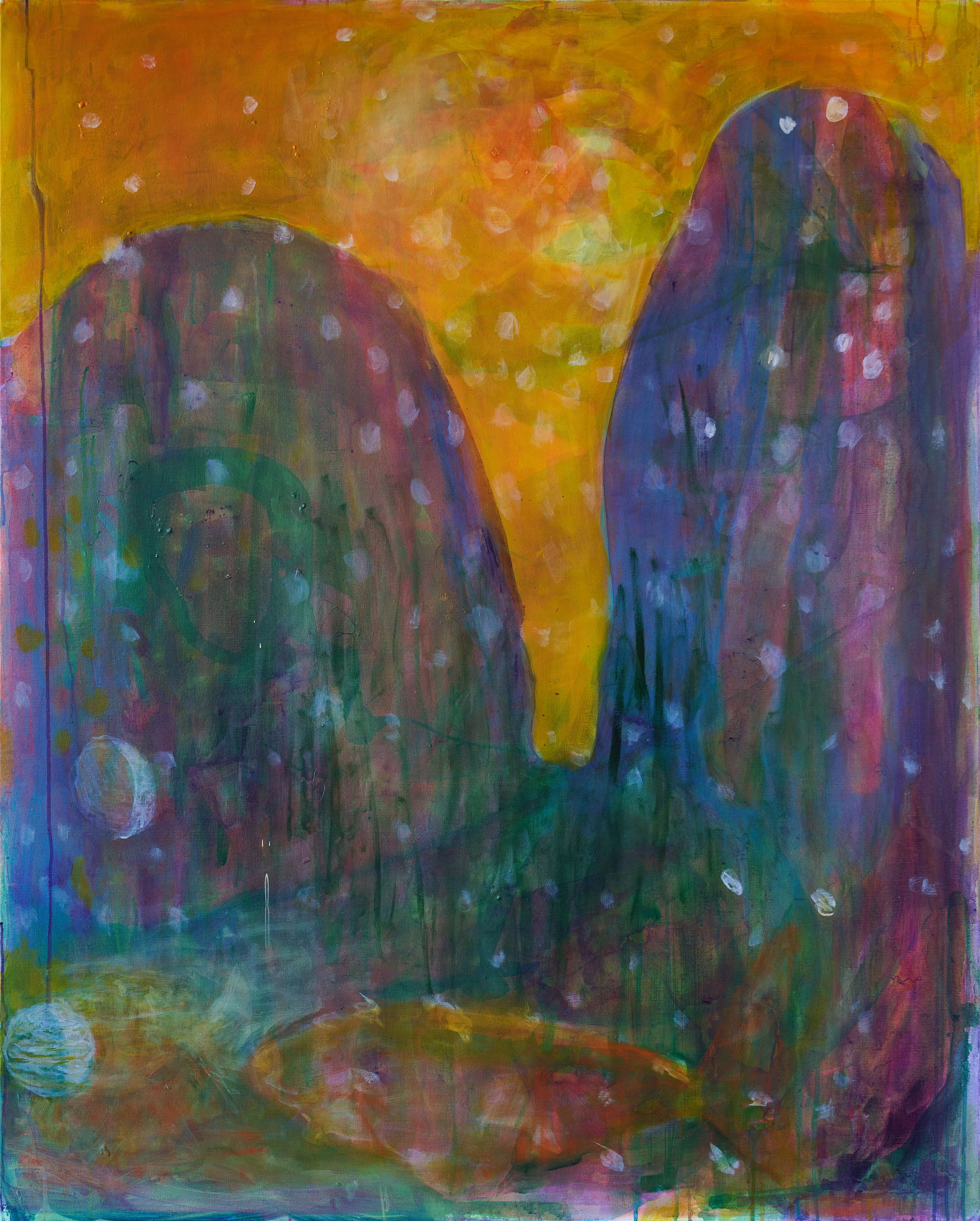
Like these artists, Jill Trappler uses colour and mark-making, often on a large scale, to evoke the invisible. Her art is about the world of the senses – feeling, hearing, smelling, touching. Describing the act of painting as liberating and ‘in the body’, she recalls blissful childhood experiences of riding on horseback through open country and finds an analogue for the act of painting in those early experiences.
Trappler’s sensual painting celebrates colour, and simultaneously texture. Almost entirely absent is outline. Where line exists, it is tentatively described in colour; it does not enclose forms. Defining lines are avoided by an artist whose urge is towards openness and fluidity.1 Line can often seem loud; Trappler’s work is, instead, all about quietness and privacy. The sensuality of this work is in a very gentle register – colours are sumptuous but soft, and softened by a textured picture surface.
Frequently, colour areas bleed into each other or thin to reveal indistinct forms beneath. Marks of colour are feathered, or smudged; coloured forms swell then fade away. There is much use of veiling: semi-transparent forms hint at others beneath them, giving a sense of layers of experience, hidden possibilities, possibilities of change. But all is very quietly evoked. The artist is interested in exploring the feminine in the psyche and these are surely very feminine images.
They are also very calming images. Again countering the trend of so much contemporary art, Trappler’s work is a celebration of the pleasures of making and viewing images: it embodies serene states of being – reflective, peaceful, meditative. While the past year has been one of sadness and great change in the artist’s personal life, the act of painting has offered a route to a rediscovery of self and a new acceptance. There is no angst, but a pleasure in sensory exploration through paint. There is even, now, an enhanced freedom – freedom from worry about ‘finish’, from anxiety about pictorial minutiae. An awareness of life’s fleetingness brings an enhanced ability to let go of a work.
The working process
The artist speaks of wanting a ‘rawness’ to prevail in her work. To this end, she works with the canvas flat on the floor until towards the end of the painting process, thus intensifying
the experience of a bodily engagement with it, rather than the more conscious and controlling relationship achieved by a vertical, eye-level encounter. Furthermore, much of the act of painting is done, literally, at arm’s length, using long brushes tied to a stick. This lessens the possibilities of tight control over mark-marking and throws up fruitful accidents. So too does the use of her non-dominant hand. And then paint is enjoyed for its colour but also for its textural qualities. Sensitive to the minute differences between different brands of pigment, Trappler uses one or another brand of paint to enhance effects of density, roughness, or transparency. Brushes might be put aside and paint dribbled, or applied in stains.
The works vary much in size but the favoured scale is large. The artist likes to work, she says, with a canvas that is a little larger than body size, thus inviting her metaphorically to swim within it. It must feel, she says, a little ’out of reach’ so that the experience is one of immersive play in something larger than the self. And this exploratory play is enhanced by the quality of light in the studio; she experiments with different lights but notes that twilight is a favourite time for working. Its ambiguity and promise of imminent departure lends a poignancy to the act of mark-making.
Light adds a poignancy to the viewer’s experience also, and is something the artist bears in mind. Will the work stay alive in different lights? She is concerned, also, about the angles from which a painting is viewed, and wants the image to work from multiple viewpoints. Paraphrasing Rothko’s ‘every square centimetre has to be a painting in itself’, she looks for the same multiplicity of entry-points to her own images.
Titles
While a multiplicity of visual angles is encouraged, so too is a multiplicity of imaginative interpretations. This touches on the issue of titles. In this current exhibition, titles have not been cited on labels next to works because of the fear that they might distract from the primarily visual/bodily experience of looking. They are available separately, for those who need them. As for the artist, she notes that the back of her canvases often contain multiple scribbled title-ideas. One will ultimately prevail, but she is entirely open to the idea that viewers might imaginatively supply their own, or that she might, at a later date, feel a different title is more appropriate.
Where do they come from, these titles? Trappler notes that, as with the images themselves, they have something of a dreamlike quality, coming unbidden when her mind is at play. And she stresses that often they bear reference to the lyrics of music she has heard and enjoyed. Music – jazz music especially – is an inspiration, its tradition of freewheeling improvisation suiting an artist whose pictorial practice stresses the same.
While the artist sees the play of the improvising jazz musician as a fitting analogy with her own practice, nevertheless she is fully aware of how much each finished work, and the corpus of works that make up an exhibition, represent a kind of triumph, finally, of mastery over chaos. It is fitting that from the world of American jazz comes the title of this exhibition: When the Cat Walks In. The title came to Trappler in a moment of dream-like meditation and she notes that it spoke of the cool cat, the urbane authority, entering the room – here the gallery space – to bring a clarity and coherence to disparate things. It speaks to her own trajectory over the past year. From a germ of an idea came each of these paintings; from the discrete paintings gathered together comes an exhibition. It is an exhibition embodying one over-riding belief, that art can be at its most powerful not when it hectors but when wordlessly it invites deep engagement with the whole self.
1 Trappler’s early training was in weaving but she notes that painting allows for far more expansive and free play with colour and form because it is largely free of the technical constraints of craftwork. It is noteworthy that her printmaking, today, has a tighter structure than her paintings, for the same reason.